In networking and digital systems, numerical identifiers often raise curiosity, especially when they resemble IP addresses. 185.63.263.20 is one such keyword that attracts attention due to its familiar dotted format. Understanding what this identifier represents, how it fits into technical standards, and why it may appear in different contexts helps users avoid confusion and interpret data correctly.
Understanding the Structure of 185.63.263.20
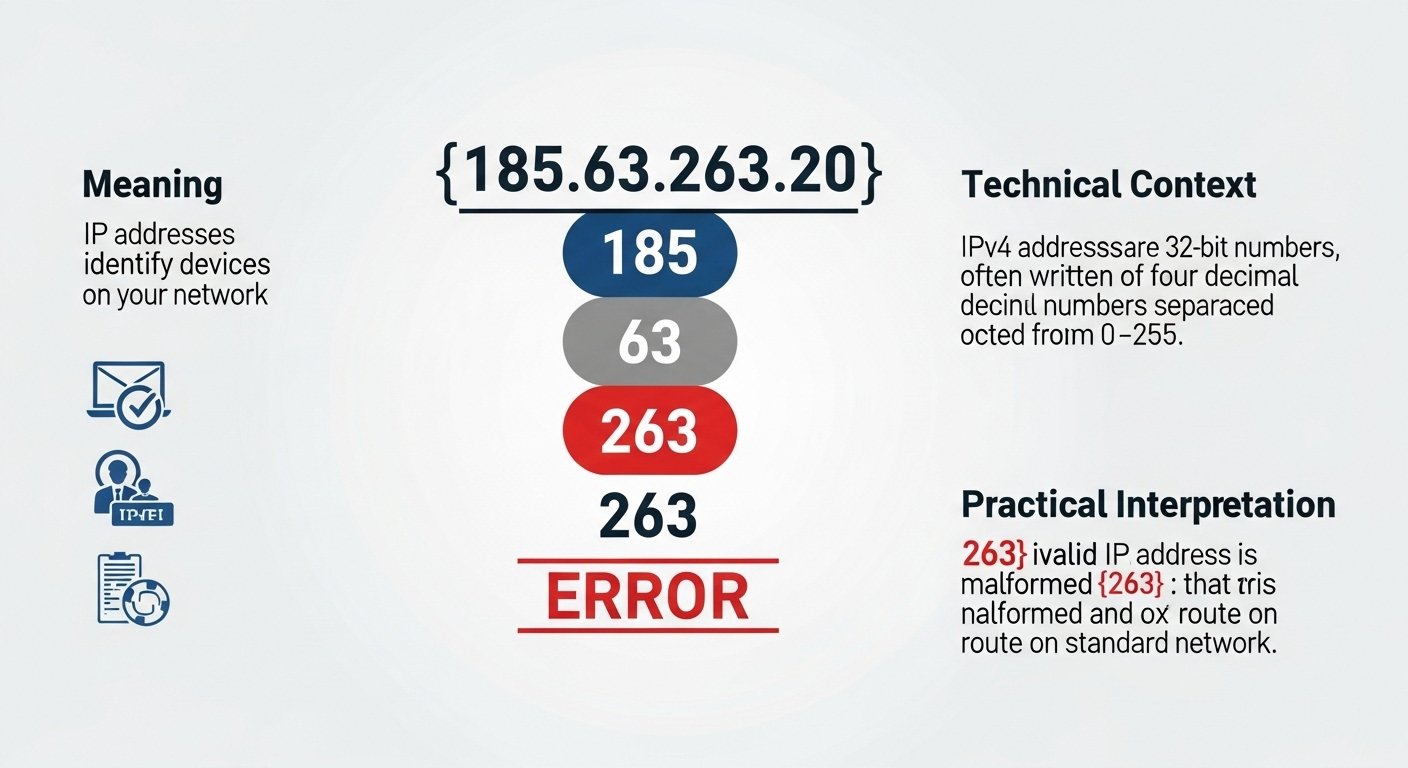
At first sight, 185.63.263.20 appears to follow the IPv4 address structure, which consists of four numerical segments separated by dots. This format is commonly used to identify devices and servers on a network. Each segment, also known as an octet, must fall within a defined numerical range to be considered valid.
When examining 185.63.263.20, the first two segments align with standard expectations, which can mislead some users into assuming the entire address is valid. A closer technical review, however, reveals that not all segments meet accepted criteria, making this identifier unsuitable for real-world routing.
Why Valid Ranges Matter in IP Addresses
IP addressing rules exist to maintain order and consistency across the internet. Every address must conform to strict numerical limits so devices can locate each other reliably. An address like 185.63.263.20 highlights why these rules are important.
When a segment exceeds the allowed range, the address cannot function as a legitimate endpoint. Recognizing this early prevents misconfigurations and helps network administrators maintain clean, efficient systems. Understanding addresses such as 185.63.263.20 strengthens overall technical awareness.
Common Scenarios Where 185.63.263.20 Appears
Despite not being usable for standard networking, 185.63.263.20 may still appear in multiple situations. Developers often use such values as placeholders during testing or documentation. In these cases, the goal is to demonstrate formatting rather than establish a connection.
System logs can also display 185.63.263.20 when handling corrupted data, incorrect user input, or unexpected traffic patterns. Seeing this identifier in logs does not necessarily indicate a threat, but it does suggest that something needs closer examination.
Diagnostic and Troubleshooting Relevance
For IT professionals, encountering 185.63.263.20 during diagnostics can provide useful clues. Invalid addresses often point to input validation issues or software bugs. By identifying and correcting these errors, teams improve system reliability.
Security teams also pay attention to unusual identifiers like 185.63.263.20. While the address itself is not dangerous, its presence may indicate automated scans, misconfigured scripts, or malformed requests. Understanding this context helps professionals respond accurately rather than overreacting.
Educational Importance of Invalid Identifiers
Learning about identifiers such as 185.63.263.20 plays an important role in networking education. Students studying IP addressing gain valuable insight by analyzing why certain addresses fail validation checks. This practical understanding reinforces theoretical knowledge.
In training environments, instructors may reference 185.63.263.20 to test awareness of address limits and formatting rules. This approach encourages learners to think critically instead of relying solely on surface-level patterns.
Professional Interpretation of 185.63.263.20
Experienced network engineers do not attempt to trace 185.63.263.20 as a real server or device. Instead, they treat it as a signal that points to a configuration issue, placeholder value, or malformed data. This mindset saves time and reduces unnecessary troubleshooting.
By recognizing the limitations of 185.63.263.20, professionals can quickly rule out external sources and focus on internal systems where corrections are most likely needed.
Conclusion
Although 185.63.263.20 visually resembles a standard IP address, it does not meet the technical requirements for valid network communication. Its value lies in education, testing, and diagnostics rather than real-world connectivity. Understanding why such identifiers appear and how to interpret them equips users and professionals with clearer insight into networking standards and digital system behavior.