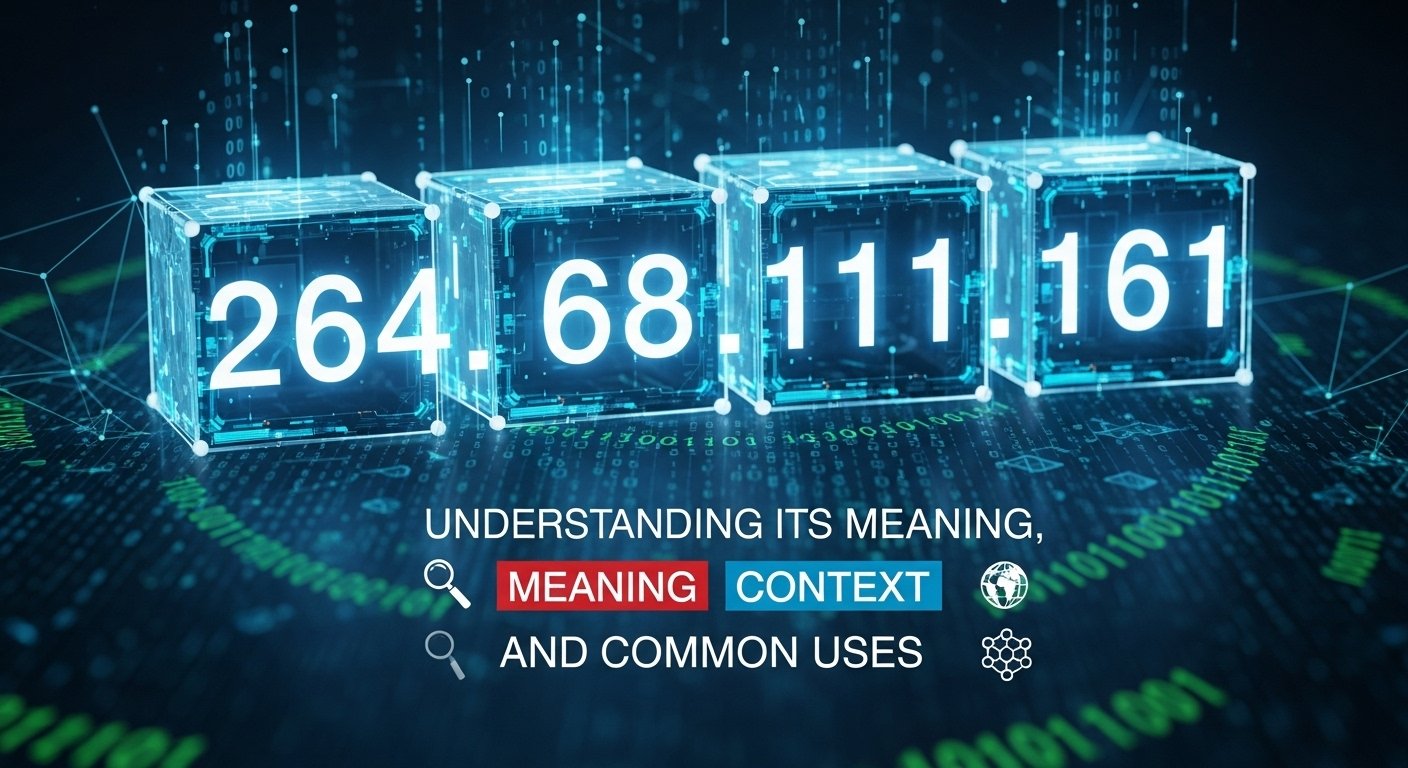
In the digital world, numerical identifiers play a critical role in how systems communicate and organize data. The keyword 264.68.111.161 appears to follow the structure of an IP-style address, which naturally draws attention from users trying to understand its purpose, validity, or relevance. Exploring what such an identifier represents can help clarify how internet addressing works and why certain formats raise technical questions.
What Is 264.68.111.161?
At first glance, 264.68.111.161 looks like an IPv4 address because it follows the familiar four-number format separated by dots. IP addresses are used to identify devices on a network, enabling communication between servers, computers, and digital services. However, understanding the rules behind IP addressing is essential to properly interpret this value.
Each segment of a standard IPv4 address must fall within a specific numerical range. When analyzing 264.68.111.161, experienced users quickly notice that the first segment exceeds the allowable range. This detail alone makes the identifier unusual and worth discussing from a technical perspective.
Why Numerical Ranges Matter in IP Structures
To understand why 264.68.111.161 stands out, it helps to know how IP addresses are constructed. IPv4 addresses consist of four octets, and each octet must fall within a defined limit. These limits exist to ensure consistency and reliability across global networks.
When an address like 264.68.111.161 appears, it signals that the value may not function as a routable address. This does not mean it has no purpose, but it does indicate that it cannot be used in standard internet communication. Recognizing this distinction prevents confusion and misconfiguration.
Common Contexts Where 264.68.111.161 May Appear
Despite its technical limitations, 264.68.111.161 can still appear in various contexts. Developers may use such values as placeholders during testing, documentation examples, or simulations. In these cases, the goal is not connectivity but structure demonstration.
Another possible use of 264.68.111.161 is within logs or error messages. Sometimes systems display malformed or invalid addresses when handling corrupted data or unexpected inputs. Identifying these patterns helps administrators diagnose issues more efficiently.
Security and Diagnostic Considerations
From a cybersecurity standpoint, recognizing invalid identifiers like 264.68.111.161 is important. Security tools often flag unusual address formats as potential indicators of misconfiguration or suspicious behavior. While an invalid address does not automatically imply a threat, it does warrant closer inspection.
Network analysts reviewing traffic logs might encounter 264.68.111.161 during audits or troubleshooting sessions. Understanding that it cannot represent a legitimate external source helps narrow down possible causes and speeds up problem resolution.
Educational Value in Understanding Invalid Addresses
There is strong educational value in examining identifiers such as 264.68.111.161. For students and beginners in networking, examples like this highlight the importance of standards and limitations. Learning why certain numbers are invalid strengthens foundational knowledge.
In training environments, instructors may intentionally reference 264.68.111.161 to test awareness of IP address rules. This approach reinforces learning by encouraging critical thinking rather than memorization.
How Professionals Interpret 264.68.111.161
Experienced IT professionals do not view 264.68.111.161 as a functional endpoint. Instead, they interpret it as a signal. It may indicate placeholder data, an input validation failure, or a system error that needs correction.
By understanding how to interpret 264.68.111.161, professionals avoid wasting time attempting to trace or locate a non-existent device. This efficiency is especially important in large-scale networks where clarity saves resources.
Conclusion
Although 264.68.111.161 resembles a traditional IP address, its structure places it outside the bounds of valid internet addressing. Rather than being a usable network identifier, it serves as a useful example for education, testing, and diagnostics. Recognizing why it is invalid helps users deepen their understanding of networking standards and improves their ability to troubleshoot digital systems effectively.